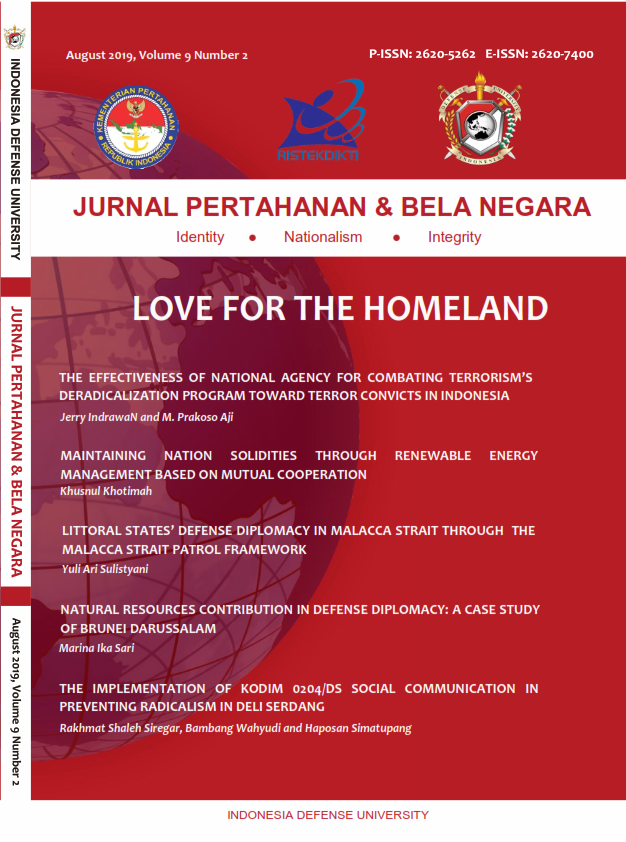
THE EFFECTIVENESS OF NATIONAL AGENCY FOR COMBATING TERRORISM’S DERADICALIZATION PROGRAM TOWARD TERROR CONVICTS IN INDONESIA
DOI:
https://doi.org/10.33172/jpbh.v9i2.571Abstract
Deradicalization programs have been implemented in Indonesia since 2012. This program employs preventive paradigm in implementing the policies it produces. During the seven years of implementation, deradicalization experienced challenges and obstacles. So far, there are many critics addressed to deradicalization program, such as criticism toward the lack of budget, prison facilities, deradicalization materials provided to terror convicts, post-deradicalization follow-up, as well as negative public reception on the idea of ex-terror convicts returning to society. These problems are hampering the effectiveness of deradicalization program. This paper employs theory of deradicalization and theory of effectiveness. It employs qualitative method with deductive and conceptual analysis, and the data is obtained through literature studies. This paper aims to see the effectiveness of deradicalization program carried out by National Agency for Combating Terrorism (BNPT) toward terror convicts in Indonesia.
Keywords: Terrorism, Deradicalization, Terror Convicts, Resocialization and Reintegration
References
Books
Bakti, Agus Surya. 2014. Darurat Terorisme: Kebijakan Pencegahan, Perlindungan, dan Deradikalisasi. Jakarta: Daulat Press.
Horgan, John. 2009. Walking Away from Terrorism: Accounts of Disengagement from Radical and Extremist Movements. New York: Routledge.
Zuhri, Saefudin (a). 2017. Deradikalisasi Terorisme. Jakarta: Daulat Press.
Handayaningrat, Soewarno. 1994. Pengantar Studi Ilmu Administrasi dan Manajemen. Jakarta: Haji Masagung.
Journals
Khamdan, Muhammad. 2015. “Rethinking Deradikalisasi: Konstruksi Bina Damai Penanganan Terorismeâ€. Jurnal Addin. Vol. 9. No. 1.
Zuhri, Saefudin (b). 2017. “Muhammadiyah dan Deradikalisasi Terorisme di Indonesia: Moderasi Sebagai Upaya Jalan Tengahâ€. Maarif. Vol. 12. No. 2.
Website
Beritasatu.com, “Kapolri Sebut Terduga Teroris Kartasura Lone Wolf, Ini Maksudnyaâ€, 5 June 2019, in https://www.beritasatu.com/nasional/558023/kapolri-sebut-terduga-teroris-kartasura-lone-wolf-ini-maksudnya, accessed on 21 June 2019.
Benarnews.org, “Penelitian: Kegiatan Inklusif Lapas Mampu Deradikalisasi Napi Terorismeâ€, 9 Februari 2018, in https://www.benarnews.org/indonesian/berita/lapas-deradikalisasi-02092018114320.html, accessed on 6 June 2019.
Detik.com, “Klaim Program Deradikalisasi Berhasil 100 Persenâ€, 22 May 2018, in https://news.detik.com/berita/d-4033545/bnpt-klaim-program-deradikalisasi-berhasil-100-persen, accessed on 30 May 2019.
Damailahindonesiaku.com, “Meski Jumlah Napi Terorisme Sedikit, Namun dalam Menanganinya Tidak Boleh Dianggap Sepeleâ€, 5 Desember 2018, in https://damailahindonesiaku.com/meski-jumlah-napi-terorisme-sedikit-namun-in-menanganinya-tidak-boleh-dianggap-sepele.html, accessed on 6 June 2019.
Gatra.com, “Penghuni Lapas Di Indonesia Kebanyakan Napi Narkobaâ€, 31 Januari 2019, in https://www.gatra.com/detail/news/386285-Penghuni-Lapas-Di-Indonesia-Kebanyakan-Napi-Narkoba, accessed on 6 June 2019.
Jurnalintelijen.net, “Mengenal Deradikalisasiâ€, 26 Oktober 2017, in https://jurnalintelijen.net/2017/10/26/mengenal-deradikalisasi/, accessed on 4 June 2019.
Kompas.com, “BNPT: Ada 289 Narapidana Terorisme yang Tersebar di 113 Lapasâ€, 30 May 2018, in https://nasional.kompas.com/read/2018/05/30/12294981/bnpt-ada-289-narapidana-terorisme-yang-tersebar-di-113-lapas, accessed on 6 June 2019.
Merdeka.com, “Hidup Mantan Napi Teroris. 11 June 2018â€, in https://www.merdeka.com/khas/hidup-mantan-napi-teroris.html, pada 4 June 2019.
Matamatapolitik.com, “Mantan Napi Teroris Indonesia, Apa yang Harus Dilakukan pada Mereka?â€, 17 Desember 2018, in https://www.matamatapolitik.com/mantan-napi-teroris-indonesia-apa-yang-harus-dilakukan-pada-mereka/, accessed on 2 June 2019.
Tirto.id, “KontraS Anggap Program Deradikalisasi Pemerintah Kurang Efektifâ€, 19 May 2018, in https://tirto.id/kontras-anggap-program-deradikalisasi-pemerintah-kurang-efektif-cKKF, accessed on 4 June 2019.
Tirto.id, “Pakar Psikologi: Deradikalisasi Napi Terorisme Butuh Waktuâ€, 11 March 2016, in https://tirto.id/pakar-psikologi-deradikalisasi-napi-terorisme-butuh-waktu-h2y, accessed on 6 June 2019.
Voaindonesia.com, “Pemerintah Perlu Evaluasi Program Deradikalisasi di Lapasâ€, 9 Februari 2018, in https://www.voaindonesia.com/a/pemerintah-perlu-evaluasi-program-deradikalisasi-di-lapas-/4244745.html, accessed on 4 June 2019.
Downloads
Published
How to Cite
Issue
Section
Citation Check
License
Proposed Policy for Journals That Offer Open Access. Authors who publish with this journal agree to the following terms:
- Authors retain copyright and grant the journal right of first publication with the work simultaneously licensed under a Creative Commons Attribution License that allows others to share the work with an acknowledgement of the work's authorship and initial publication in this journal.
- Authors are able to enter into separate, additional contractual arrangements for the non-exclusive distribution of the journal's published version of the work (e.g., post it to an institutional repository or publish it in a book), with an acknowledgement of its initial publication in this journal.
- Authors are permitted and encouraged to post their work online (e.g., in institutional repositories or on their website) prior to and during the submission process, as it can lead to productive exchanges, as well as earlier and greater citation of published work (See The Effect of Open Access).
Proposed Policy for Journals That Offer Delayed Open Access. Authors who publish with this journal agree to the following terms:
- Authors retain copyright and grant the journal right of first publication, with the work [SPECIFY PERIOD OF TIME] after publication simultaneously licensed under a Creative Commons Attribution License that allows others to share the work with an acknowledgement of the work's authorship and initial publication in this journal.
- Authors are able to enter into separate, additional contractual arrangements for the non-exclusive distribution of the journal's published version of the work (e.g., post it to an institutional repository or publish it in a book), with an acknowledgement of its initial publication in this journal.