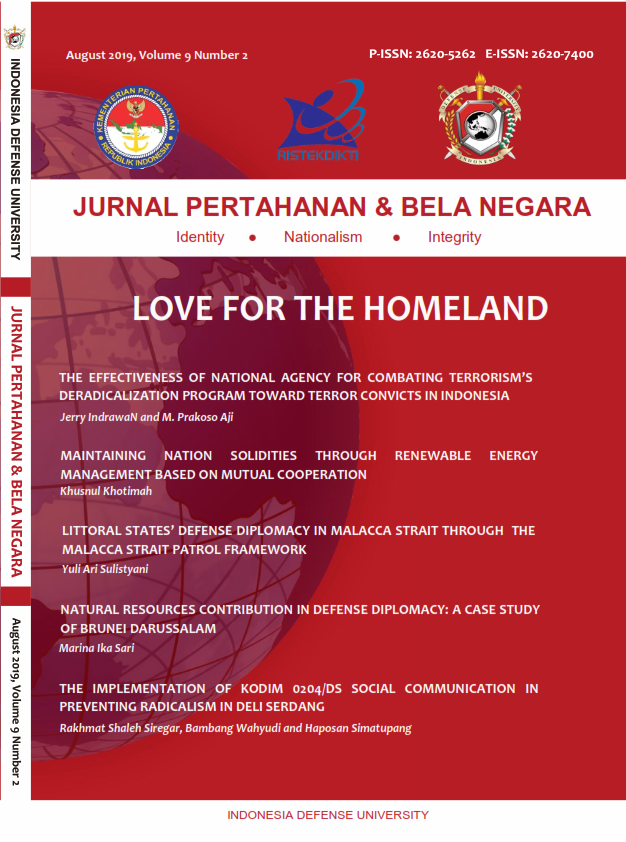
LITTORAL STATES’ DEFENSE DIPLOMACY IN MALACCA STRAIT THROUGH THE MALACCA STRAIT PATROL FRAMEWORK
DOI:
https://doi.org/10.33172/jpbh.v9i2.573Abstract
Malacca Strait, as one of the strategic straits in world trade, often face various non-traditional security threats. In accordance with United Nations Convention on the Law of The Sea (UNCLOS), littoral states such as Indonesia, Singapore, and Malaysia are obligated to maintain the security in Malacca Straits, to ensure that world trades and world economic are not disrupted. This study analyzes how the Malacca straits patrol (MSP) framework is formed by littoral states in order to maintain the security stability in Malacca Strait. The authors employ qualitative method through literature study. The obtained data were analyzed using the theory of defense cooperation and concept of defense diplomacy. The results of the study conclude that MSP, which is consisted of the Malacca Straits Sea Patrol (MSSP), "Eyes-in-the-Sky" Combined Maritime Air Patrols (EiS), and the MSP Intelligence Exchange Group (IEG), is classified as a defense diplomacy activity in the form of multilateral contacts between military officials and multilateral military exercises aimed at increasing mutual trust and defense capabilities of each country.
Keywords: Â Malacca Strait, Malacca Straits Patrol Framework, Threat, Defense Cooperation, Defense Diplomacy
References
Books
Cottey, A., & Forster, A. (2004). Reshaping Defense Diplomacy: New Role for Military Cooperation and Assistance. New York: Oxford University Inc.
Liss, C., & Biggs, T. (2016). Piracy in Southeast Asia; Trends, Hot Spots, and Responses. London: Routledge.
Simamora, P. (2013). Peluang dan Tantangan Diplomasi Pertahanan. Yogyakarta: Graha Ilmu.
Supriyatno, M. (2014). Tentang Ilmu Pertahanan. Jakarta: Yayasan Obor.
Tangredi, Sam J. (2002). Globalization and Sea Power: Overview and Context, in Sam J. Tangredi (ed.). Globalization and Maritime Power, Institute for National Strategic Studies, National Defense University Press, p. 1-2.
Journals
Brewster, David. (2010) “An Indian Sphere of Influence in the Indian Ocean?â€. Security Challenges, Vol. 6, No. 3, p. 1-20.
Fitriyadi,F., Hara, A. E., & Supriyadi. “Kepentingan Indonesia dalam Kerjasama Keamanan di Selat Malakaâ€. E-Journal Ilmu Hubungan Internasional, p. 6. accessed from http://repository.unej.ac.id/bitstream/handle/123456789/71596/Fajar%20Fitriyadi.pdf?sequence=1 accessed on 21 June 2019
Manners, Andrew. (2014). “Moving Forward, Slowly: India-Indonesia Relations in the Twenty-First Century,†Strategic Analysis Paper, p. 1-8.
Putri, A.N. (2016). “Kerjasama Indonesia, Malaysia, dan Singapura di Selat Malaka dalam Menangani Perampokan Bersenjata Tahun 2004-2013.†Journal of International Relations. Vol. 2. No. 3, p. 252-253.
Thesis and Research Report
Sari, Marina Ika. (2017). Diplomasi Pertahanan Indonesia terhadap India atas Kepentingan Nasional Indonesia di Samudera Hindia. Thesis. Bogor: Universitas Pertahanan.
Hartanto. (2016). Ancaman Pembajakan dan Perampokan Bersenjata di Selat Malaka (Kajian Laporan IMB Periode 2016) Terhadap Tegaknya Kedaulayan NKRI. Thesis. Bogor: Universitas Pertahanan.
Hartono, B. (2016). Startegi Diplomasi Pertahanan Indonesia terhadap Arms Trade Treaty (ATT) di Perserikatan Bangsa-Bangsa. Thesis. Bogor: Universitas Pertahanan.
Ismail, Siti Zubaidah and Sani, Mohd Azizuddin Mohd. The Straits of Malacca: Regional Powers Vis-A-Vis Littoral States in Strategic and Security Issues and Interests. Seminar on National Resilience Political Managements and Policies in Malaysia. accessed from https://core.ac.uk/download/pdf/12118559.pdf, on 25 June 2019
Lestari, A. (2013). Strategi Pertahanan Indonesia di Selat Malaka : Tawaran Proliferation Security Initiative 2006- 2008. Thesis. Jakarta: Universitas Indonesia.
Pedrason, R. (2015). ASEAN’s Defence Diplomacy : The Road to Southeast Asian Defence Community. Disertasi. Heidelberg : Ruprecht-Karls-Universitat
Yunianto, M. (2016). Kontribusi Integrated Maritime Surveillance System Terhadap Penangkalan Ancaman di perairan Selat Malaka. Thesis. Bogor: Universitas Pertahanan.
Internet
Singapore Ministry of Defence. (21 April 2015). Fact Sheet: The Malacca Straits Patrol, accessed from https://www.mindef.gov.sg/imindef/press_room/official_releases/nr/2016/apr/21apr16_nr/21apr15_fs.html on 22 June 2019.
Taufan, M. (23 Juli 2018). 7 Hal yang Jarang Diketahui Tentang Selat Malaka, accessed from https://kumparan.com/muhammad-taufan1530163979173/tujuh-hal-yang-jarang-diketahui-orang-tentang-selat-malaka-27431110790551702 on 24 June 2019
Downloads
Published
How to Cite
Issue
Section
Citation Check
License
Proposed Policy for Journals That Offer Open Access. Authors who publish with this journal agree to the following terms:
- Authors retain copyright and grant the journal right of first publication with the work simultaneously licensed under a Creative Commons Attribution License that allows others to share the work with an acknowledgement of the work's authorship and initial publication in this journal.
- Authors are able to enter into separate, additional contractual arrangements for the non-exclusive distribution of the journal's published version of the work (e.g., post it to an institutional repository or publish it in a book), with an acknowledgement of its initial publication in this journal.
- Authors are permitted and encouraged to post their work online (e.g., in institutional repositories or on their website) prior to and during the submission process, as it can lead to productive exchanges, as well as earlier and greater citation of published work (See The Effect of Open Access).
Proposed Policy for Journals That Offer Delayed Open Access. Authors who publish with this journal agree to the following terms:
- Authors retain copyright and grant the journal right of first publication, with the work [SPECIFY PERIOD OF TIME] after publication simultaneously licensed under a Creative Commons Attribution License that allows others to share the work with an acknowledgement of the work's authorship and initial publication in this journal.
- Authors are able to enter into separate, additional contractual arrangements for the non-exclusive distribution of the journal's published version of the work (e.g., post it to an institutional repository or publish it in a book), with an acknowledgement of its initial publication in this journal.