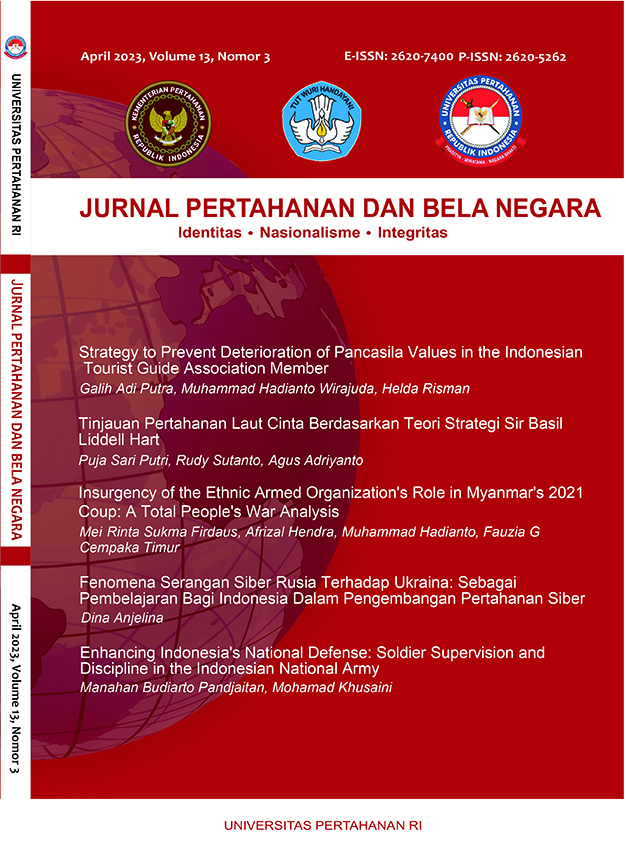
FENOMENA SERANGAN SIBER RUSIA TERHADAP UKRAINA: SEBAGAI PEMBELAJARAN BAGI INDONESIA DALAM PENGEMBANGAN PERTAHANAN SIBER
DOI:
https://doi.org/10.33172/jpbh.v13i3.14307Keywords:
Keamanan Nasional, perang, pertahanan siber, Rusia dan Ukraina, serangan siberAbstract
Rusia, sebagai negara great power, sukses melumpuhkan infrastruktur Ukraina melalui serangan siber untuk melakukan aneksasi. Serangan siber Rusia menarik perhatian utama dalam keamanan global, dengan potensi terjadi di negara lain, termasuk Indonesia. Diperlukan peningkatan bentuk pertahanan siber di setiap negara untuk mengantisipasinya. Penelitian ini bertujuan untuk menganalisis jenis serangan siber apa saja yang dilakukan oleh Rusia terhadap Ukraina. Selain itu, penelitian ini juga mengidentifikasi bagaimana upaya negara Indonesia dalam meningkatkan pertahanan siber sebagai bentuk kewaspadaan Indonesia. Metode penelitian yang digunakan adalah metode deskriptif melalui pendekatan kualitatif dengan data bersumber dari studi kepustakaan. Hasil penelitian ini adalah jenis serangan siber yang digunakan Rusia yaitu DDoS (Distributed Denial of Service), malware, ransomwar, dan phising. Adapun bentuk pengembangan pertahanan siber Indonesia yakni melalui teknik kriptografi, pembentukan tentara siber, dan bekerja sama dengan komunitas teknologi informasi.
References
Abaimov, Stanislav, & Martellini, Maurizio. (2020). Cyber arms: security in cyberspace (Myriam Dunn Cavelty & Andreas Wenger, Eds.). Retrieved from https://www.google.com/books?hl=id&lr=&id=ui3tDwAAQBAJ&oi=fnd&pg=PT5&dq=Cyber+is+no+longer+just+a+communication+channel+or+an+economic+tool,+but+also+a+battleground+that+plays+a+key+role+in+determining+a+country%27s+security.&ots=AAMfIwxQk1&sig=ZFmV2kYhJmbg-bHnpfYUr50Stuk
Aleshkovski, Ivan, Bondarenko, Valentina, & Ilyin, Ilya. (2020). Global values, digital transformation and development strategy for global society: conceptual framework. International Journal of Foresight and Innovation Policy, 14(2/3/4), 120. https://doi.org/10.1504/IJFIP.2020.111243
Baezner, Marie. (2018). Cyber and Information warfare in the Ukrainian conflict. ETH Zurich.
BAŞARAN, Ali. (2020). Annexation Of Crimea By Russian Federation, United States And European Union’s Economic Sanctions Against Russian Federation, 2014-2018. Asya Studies, 4(11), 91–106. https://doi.org/10.31455/asya.686618
Bentzen, Naja. (2020). Ukraine: The Minsk agreements five years on. Retrieved from EPRS: European Parliamentary Research Service website: https://www.europarl.europa.eu/thinktank/en/document/EPRS_ATA(2020)646203
Caton, Jeffrey L., & Libicki, Martin C. (2024). [Review of Cyberdeterrence and Cyberwar]. Strategic Studies Quarterly. Strategic Studies Quarterly, 5(1), 148–150. Retrieved from http://www.jstor.org/stable/26270515
Child, David, Gadzo, Mersiha, Rasheed, Zaheena, Harb, Ali, & Marsi, Federica. (2022). Ukraine latest updates: NATO will ‘respond’ to chemical weapons Ukraine-Russia news from March 24: US President Joe Biden warns Russia against using chemical weapons in Ukraine. Retrieved October 22, 2023, from https://www.aljazeera.com/news/2022/3/23/us-president-biden-arrives-in-brussels-ahead-of-nato-summit-liveblog
de Hoon, Marieke. (2019). Pursuing Justice for MH17: The Role of the Netherlands. Netherlands Yearbook of International Law 2018: Populism and International Law, 245–270.
De Hoon, Marieke. (2017). Navigating the legal horizon: Lawyering the MH17 disaster. Utrecht J. Int’l & Eur. L., 33, 90.
Douzet, Frédérick, & Gery, Aude. (2021). Cyberspace is used, first and foremost, to wage wars: proliferation, security and stability in cyberspace. Journal of Cyber Policy, 6(1), 96–113. https://doi.org/10.1080/23738871.2021.1937253
Jaitner, Margarita, & Geers, Kenneth. (2015). Russian information warfare: Lessons from Ukraine. Cyber War in Perspective: Russian Aggression against Ukraine, 87–94.
Kementerian Pertahanan Indonesia. Peraturan Menteri Pertahanan Nomor 82 Tahun 2014 tentang Pedoman Pertahanan Sibe. , (2014).
Kotoulas, Ioannis E., & Pusztai, Wolfgang. (2022). Geopolitics of the War in Ukraine. Foreign Affairs Institute.
Lehto, Martti. (2022). Cyber-attacks against critical infrastructure. In Cyber Security: Critical Infrastructure Protection (pp. 3–42). Springer.
Lewis, James Andrew. (2022). Cyber War and Ukraine. Retrieved from https://www.csis.org/analysis/cyber-war-and-ukraine
Li, Yuchong, & Liu, Qinghui. (2021). A comprehensive review study of cyber-attacks and cyber security; Emerging trends and recent developments. Energy Reports, 7, 8176–8186. https://doi.org/10.1016/j.egyr.2021.08.126
Marples, David R. (2017). Ukraine in Conflict An Analytical Chronicle. In E-International Relations. Retrieved from https://www.e-ir.info/wp-content/uploads/2017/05/Ukraine-in-Conflict-E-IR.pdf
Marsh, Sarah. (2018). US joins UK in blaming Russia for NotPetya cyber-attack. In Cybercrime. Retrieved from https://www.theguardian.com/technology/2018/feb/15/uk-blames-russia-notpetya-cyber-attack-ukraine
Mueller, G., Jensen, Benjamin, Valeriano, Brandon, Maness, R., & Macias, J. (2023). Cyber operations during the Russo–Ukrainian war. In Center for Strategic Int. Studies, Washington, DC, USA. Retrieved from JSTOR website: https://www.jstor.org/stable/resrep52130
O’Neill, Patrick Howell. (2022). Russia hacked an American satellite company one hour before the Ukraine invasion. Retrieved from https://www.technologyreview.com/supertopic/about/
Person, Robert, & McFaul, Michael. (2022). What Putin fears most. Journal of Democracy, 33(2), 18–27. Retrieved from https://www.journalofdemocracy.org/articles/what-putin-fears-most/
Pratiwi, Febriana Sulistya. (2023). BSSN Catat 370,02 Juta Serangan Siber ke Indonesia pada 2022. Retrieved from https://dataindonesia.id/internet/detail/bssn-catat-37002-juta-serangan-siber-ke-indonesia-pada-2022
Rõigas, Henry. (2018). Cyber war in perspective: lessons from the conflict in Ukraine. A Civil-Military Response to Hybrid Threats, 233–257.
Romandash, Anna. (2023). Ukraine’s IT Army: Digital Resistance to Russian Propaganda. https://doi.org/10.7274/qr46qz24c90
Schulze, Matthias. (2020). Cyber in War: Assessing the Strategic, Tactical, and Operational Utility of Military Cyber Operations. 2020 12th International Conference on Cyber Conflict (CyCon), 1300, 183–197. https://doi.org/10.23919/CyCon49761.2020.9131733
Silva, Paul M., & Selden, Zachary. (2020). Economic interdependence and economic sanctions: a case study of European Union sanctions on Russia. Cambridge Review of International Affairs, 33(2), 229–251. https://doi.org/10.1080/09557571.2019.1660857
Strømmen-Bakhtiar, Abbas. (2020). Introduction to Digital Transformation: and its impact on society. Informing Science Press.
VOA News. (2022). Ukraine Demands Russia Allow Aid into Mariupol and Open a Corridor for Safe Civilian Passage. Retrieved November 23, 2023, from VOA News website: https://www.voanews.com/a/biden-russia-may-use-cyberattacks-chemical-weapons-/6495562.html
Zamir, Hassan. (2020). Cybersecurity and Social Media. Cybersecurity for Information Professionals: Concepts and Applications, 153.
Zed, Mestika. (2008). Metode penelitian kepustakaan. Yayasan Pustaka Obor Indonesia.
Zhang, Qi, Hu, Yi, Jiao, Jianbin, & Wang, Shouyang. (2024). The impact of Russia–Ukraine war on crude oil prices: an EMC framework. Humanities and Social Sciences Communications, 11(1), 8. https://doi.org/10.1057/s41599-023-02526-9
Downloads
Additional Files
Published
How to Cite
Issue
Section
Citation Check
License
Proposed Policy for Journals That Offer Open Access. Authors who publish with this journal agree to the following terms:
- Authors retain copyright and grant the journal right of first publication with the work simultaneously licensed under a Creative Commons Attribution License that allows others to share the work with an acknowledgement of the work's authorship and initial publication in this journal.
- Authors are able to enter into separate, additional contractual arrangements for the non-exclusive distribution of the journal's published version of the work (e.g., post it to an institutional repository or publish it in a book), with an acknowledgement of its initial publication in this journal.
- Authors are permitted and encouraged to post their work online (e.g., in institutional repositories or on their website) prior to and during the submission process, as it can lead to productive exchanges, as well as earlier and greater citation of published work (See The Effect of Open Access).
Proposed Policy for Journals That Offer Delayed Open Access. Authors who publish with this journal agree to the following terms:
- Authors retain copyright and grant the journal right of first publication, with the work [SPECIFY PERIOD OF TIME] after publication simultaneously licensed under a Creative Commons Attribution License that allows others to share the work with an acknowledgement of the work's authorship and initial publication in this journal.
- Authors are able to enter into separate, additional contractual arrangements for the non-exclusive distribution of the journal's published version of the work (e.g., post it to an institutional repository or publish it in a book), with an acknowledgement of its initial publication in this journal.