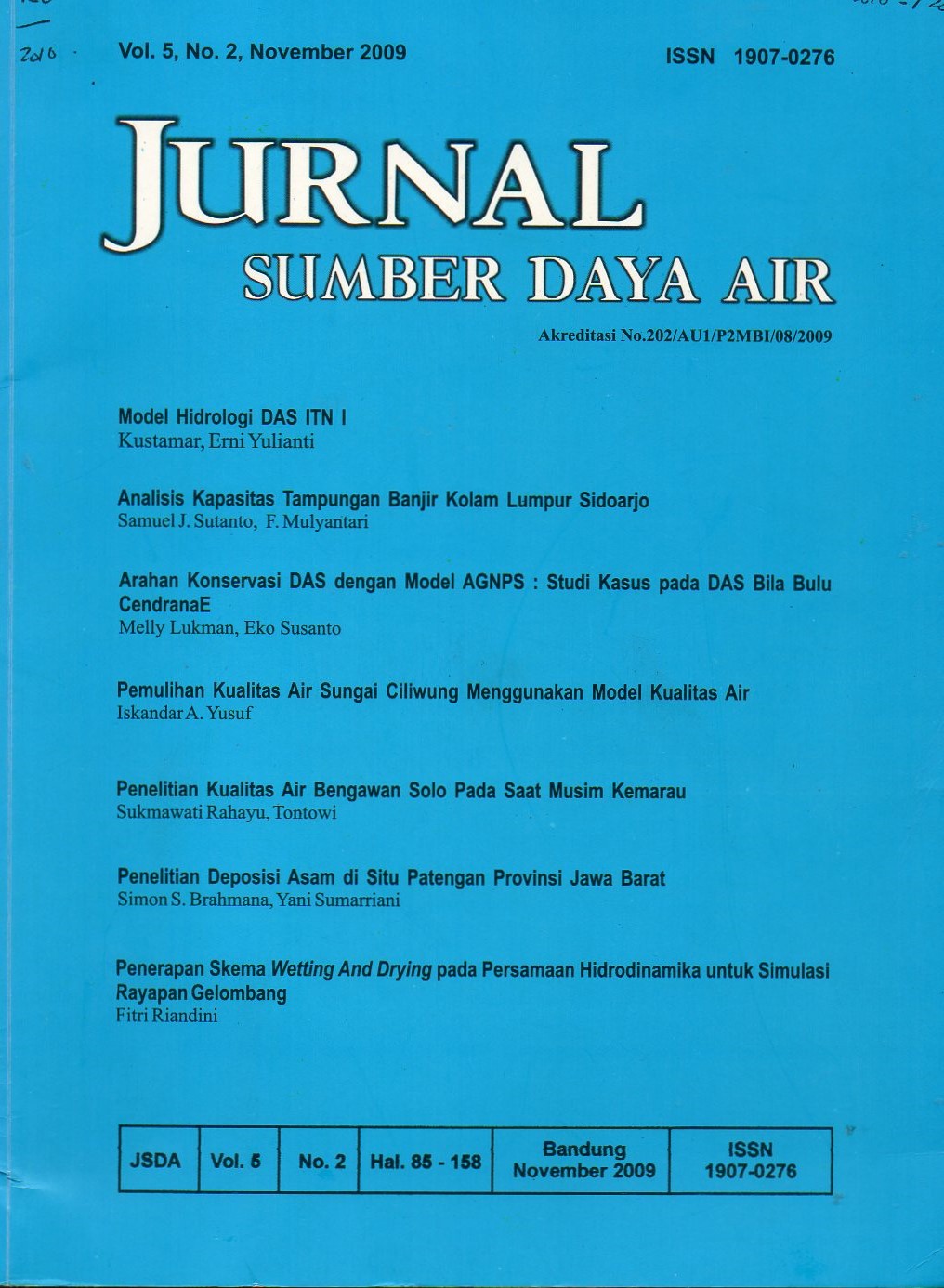
PENERAPAN SKEMA WETTING AND DRYING PADA PERSAMAAN HIDRODINAMIKA UNTUK SIMULASI RAYAPAN GELOMBANG
DOI:
https://doi.org/10.32679/jsda.v5i2.474Keywords:
wetting & drying, tsunami's run up.Abstract
Wetting and drying (WAD) are common and important phenomena of the coastal ocean. They occur in
low-lying coastal zones and also in embayment and inlets. Strong winds and/or tides can cause flooding and
subsequent drying. In shallow water models, wetting and drying are determined by the total depth D = 0 for
'dry' and D>0 for 'wet'. The scheme defines 'dry' cells as region with a thin film fluid. The primitive
equations are solved in the thin film as well as in other regular wet cells. The scheme was applied to
hydrodynamics model to simulate tsunami's run up at Banda Aceh (Nanggroe Aceh Darussalam) and
Pangandaran (West Java). Simulation results show that run up height at Banda Aceh reach more than 5 m,
while at Pangandaran more than 3 m.
References
Anonim, (2006), Identifikasi Kerusakan
Bangunan Muara-Pantai Paska Tsunami Laut
Selatan 17 Juli 2006, Laporan Kegiatan Balai
Pantai Puslitbang SDA, Hal 3.
Blumberg, A.F. and G.L. Mellor (1987): A
description of a three-dimensional
coastal ocean circulation model, Three -
dimensional ocean model, Norman S. Heaps
(ed), American Geophysical Union,
Washington DC, Hal 1-16.
HydroQual (2002), A Primer for ECOMSED
Version 1.3; User Manual, HydroQual Inc.,
New Jersey, Hal 7-11.
Oey, L.Y., (2005), A wetting and drying scheme
for POM, Ocean Modelling 9 pp 133-150,
ELSEVIER, Hal 2-4.
Oey, L.Y., (2006), An OGCM with movable
land-sea boundaries, Ocean Modelling 16 pp
-195, ELSEVIER, Hal 2-3.
Mellor, G.L., (2002), User's Guide for a Three
Dimensional Primitive Equation, Numerical
Ocean Model, Program in Atmospheric &
Oceanic Sciences, Princeton University
Downloads
Published
How to Cite
Issue
Section
Citation Check
License
Authors who publish in Jurnal Sumber Daya Air agree to the following terms:
- Authors retain copyright and grant the journal right of first publication with the work simultaneously licensed under a Attribution-ShareAlike 4.0 International (CC BY-SA 4.0) License that allows others to share the work with an acknowledgment of the work's authorship and initial publication in this journal.
- Authors are able to enter into separate, additional contractual arrangements for the non-exclusive distribution of the journal's published version of the work (e.g., post it to an institutional repository or publish it in a book), with an acknowledgment of its initial publication in this journal.
- Authors are permitted and encouraged to post their work online (e.g., in institutional repositories or on their website) prior to and during the submission process, as it can lead to productive exchanges, as well as earlier and greater citation of published work (See The Effect of Open Access).