HIDROSTRATIGRAFI DAN GEOMETRI AKUIFER CEKUNGAN AIR TANAH PALU, PROVINSI SULAWESI TENGAH PASCA GEMPA BUMI
DOI:
https://doi.org/10.32679/jsda.v17i1.695Abstract
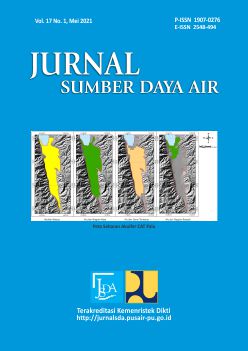
Palu Groundwater Basin can be assumed to have a post-earthquake deformation in 2018. To identify current state of Palu Groundwater Basin, modeling approach was conducted using GMS 10.4 (Groundwater Modeling System) with IDW (Inverse Distance Weighting), with the data used for the model was obtained from 41 boreholes. The results show that Palu Groundwater Basin aquifer geometry can be divided into 4 types. The unconfined aquifer consisting of Alluvium and Coastal Deposits (Qa) have an area 412,69 km², with 17,77 - 72.48 m thickness top layer have elevation 341 MSL (mean sea level) and bottom layer have elevation -2,29 MSL. Top aquitard consisting of Celebes Mollase of Sarasin and Sarasin (QTms) have an area 391,1 km² with 0.1 - 20,61 mm thickness top layer have elevation 268,52 MSL and the bottom of layer have elevation -20,06 MSL. Confined aquifer consisting of Celebes Mollase of Sarasin and Sarasin (QTms) have an area 351,98 km² with 20,58 - 86,51 m thickness top layer have elevation 268,42 MSL and bottom layer have elevation -40,67 msl. Bottom aquitard consisting of Granite and Granodiorite (Tmpi), Tinombo Formation (Tts), Metamorphic Complex (Km), Latimojong Formation (Kls) have an area 78,24 km² with 20,58 - 86,51 m thickness 3,01 - 4,1 m top layer have elevation 181,91 MSL and bottom layer have elevation -29,09 MSL
Keywords: Groundwater, basin, modeling, geometry, aquifer
Downloads
Published
How to Cite
Issue
Section
Citation Check
License
Authors who publish in Jurnal Sumber Daya Air agree to the following terms:
- Authors retain copyright and grant the journal right of first publication with the work simultaneously licensed under a Attribution-ShareAlike 4.0 International (CC BY-SA 4.0) License that allows others to share the work with an acknowledgment of the work's authorship and initial publication in this journal.
- Authors are able to enter into separate, additional contractual arrangements for the non-exclusive distribution of the journal's published version of the work (e.g., post it to an institutional repository or publish it in a book), with an acknowledgment of its initial publication in this journal.
- Authors are permitted and encouraged to post their work online (e.g., in institutional repositories or on their website) prior to and during the submission process, as it can lead to productive exchanges, as well as earlier and greater citation of published work (See The Effect of Open Access).