ANALISIS POLA DISTRIBUSI CURAH HUJAN LEBAT DOMINAN DI DAERAH ALIRAN SUNGAI (DAS) CITANDUY HULU
DOI:
https://doi.org/10.32679/jsda.v20i2.894Abstract
Rainfall plays an important role in hydrological and environmental planning. Meteorological conditions affect rainfall through its intensity, amount, and duration. However, heavy rainfall can cause significant damage and loss. Research was conducted in the Upper Citanduy watershed, West Java, using rainfall data from 8 stations over a range of 5–14 years. The study took a heavy rainfall event threshold of ≥ 50 mm in 24 hours. The research aims to analyze the dominant heavy rainfall patterns in the Upper Citandyu watershed. Empirical analysis used the Mononobe Method and Alternating Block Method (ABM), while rainfall distribution was analyzed with Inverse Distance Weighted (IDW) using Geographic Information Systems. The dominant heavy rainfall duration in the Upper Citanduy watershed occurred over 4–6 hours. Rainfall distribution analysis showed a pattern that was not influenced by the elevation of the rainfall station. The analysis results show that the Mononobe Method is closer to the dominant observed heavy rainfall distribution for 4 hours, while ABM is closer to the durations of 5 and 6 hours. The suitability of the distribution pattern was measured using Correlation (r), Root Mean Squared Error (RMSE), and Nash-Sutcliffe Efficiency (NSE) criteria, with Mononobe providing better results than ABM method. This research contributes to the understanding of rainfall patterns that can form the basis for analyzing designed rainfall intensity as a step in flood disaster mitigation in the Upper Citanduy watershed.
Keywords: heavy rainfall, rainfall distribution pattern, rainfall intensity, upper Citanduy watershed, geographic information system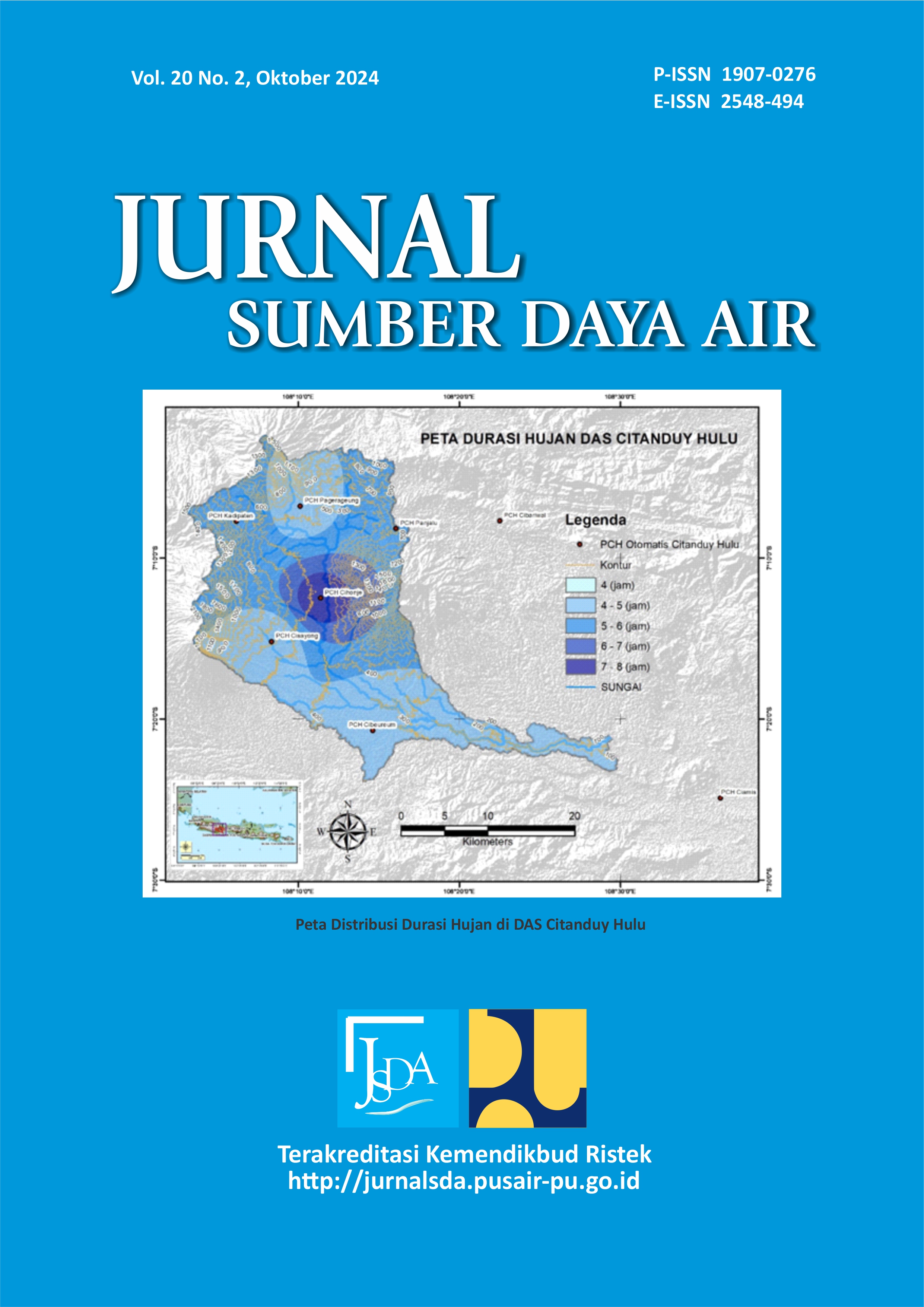
Downloads
Published
How to Cite
Issue
Section
Citation Check
License
Authors who publish in Jurnal Sumber Daya Air agree to the following terms:
- Authors retain copyright and grant the journal right of first publication with the work simultaneously licensed under a Attribution-ShareAlike 4.0 International (CC BY-SA 4.0) License that allows others to share the work with an acknowledgment of the work's authorship and initial publication in this journal.
- Authors are able to enter into separate, additional contractual arrangements for the non-exclusive distribution of the journal's published version of the work (e.g., post it to an institutional repository or publish it in a book), with an acknowledgment of its initial publication in this journal.
- Authors are permitted and encouraged to post their work online (e.g., in institutional repositories or on their website) prior to and during the submission process, as it can lead to productive exchanges, as well as earlier and greater citation of published work (See The Effect of Open Access).