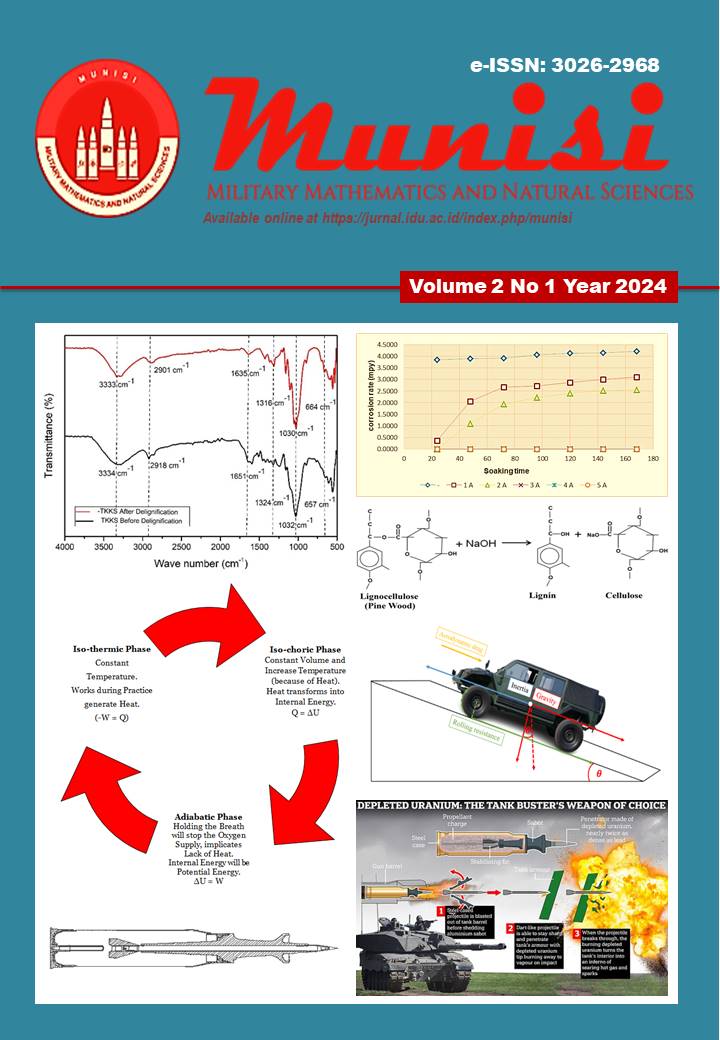
Aluminum Material as a Solution to Create Strong and Lightweight Combat Vehicles with Increased Efficiency from Fuel Savings
Keywords:
Almunium, Combat Vehicle, Mass Reduction, Efficiency, fuelAbstract
In the current era, combat vehicles are required for strong defense, extensive expedition, agile or nimble and lethal, with greater ability to conduct special operations. One of the problems in combat vehicles is their weight which makes a significant factor in their ability to achieve endurance with agility and speed. Some research shows that aluminum material is the solution to overcome the weight and durability of combat vehicles. Research shows how the determination of aluminum material in general can greatly save fuel when the mass is reduced from 0-15%. From this research, we hope to open people's minds, that the importance of specifying the material used for military vehicles by improving vehicle functions in terms of speed, strength, and fuel efficiency.
References
Miri, I., Fotouhi, A., & Ewin, N. (2021). Electric vehicle energy consumption modelling and estimation—A case study. International Journal of Energy Research, 45(1), 501–520. https://doi.org/10.1002/er.5700
Lightweight and Propulsion Materials. (n.d.). Energy.gov. https://www.energy.gov/eere/vehicles/lightweight-and-propulsion-materials#:~:text=A%2010%25%20reduction%20in%20vehicle,object%20than%20a%20heavier%20one.
PT. Pindad (Persero) - Kendaraan Taktis Maung 4x4. (n.d.). https://pindad.com/maung
Polsen, E., Krogsrud, L., Carter, R., Oberle, W., Haines, C., & Littlefield, A. (2014). Lightweight Combat Vehicle S&T Campaign Project Final Technical Report.
Caffrey, C., Bolon, K., Kolwich, G., Johnston, R., & Shaw, T. (2015). Cost-Effectiveness of a Lightweight Design for 2020-2025: An Assessment of a Light-Duty Pickup Truck. SAE Technical Papers, 2015-April(April). https://doi.org/10.4271/2015-01-0559
Ross, M. (1997). Fuel efficiency and the physics of automobiles. Contemporary Physics, 38(6), 381–394. https://doi.org/10.1080/001075197182199
Peppas, A., Kollias, K., Dragatogiannis, D. A., & Charitidis, C. A. (2021). Sustainability analysis of aluminium hot forming and quenching technology for lightweight vehicles manufacturing. International Journal of Thermofluids, 10. https://doi.org/10.1016/j.ijft.2021.100082
Das, S., Graziano, D., Upadhyayula, V. K. K., Masanet, E., Riddle, M., & Cresko, J. (2016). Vehicle lightweighting energy use impacts in U.S. light-duty vehicle fleet. Sustainable Materials and Technologies, 8, 5–13. https://doi.org/10.1016/j.susmat.2016.04.001
Henggeler, J., & Kenny, N. (n.d.). Measuring Diesel Fuel Consumption to Estimate Engine Efficiency Evaluating Diesel Pumping Plant Efficiency.
Beatrice, C., Rispoli, N., di Blasio, G., Konstandopoulos, A. G., Papaioannou, E., & Imren, A. (2016). Impact of Emerging Engine and After-Treatment Technologies for Improved Fuel Efficiency and Emission Reduction for the Future Rail Diesel Engines. Emission Control Science and Technology, 2(2), 99–112. https://doi.org/10.1007/s40825-016-0035-1
Fiebig, M., Wiartalla, A., Holderbaum, B., & Kiesow, S. (2014). Particulate emissions from diesel engines: Correlation between engine technology and emissions. In Journal of Occupational Medicine and Toxicology (Vol. 9, Issue 1). BioMed Central Ltd. https://doi.org/10.1186/1745-6673-9-6
Wong, V. W., & Tung, S. C. (2016). Overview of automotive engine friction and reduction trends–Effects of surface, material, and lubricant-additive technologies. In Friction (Vol. 4, Issue 1). Tsinghua University Press. https://doi.org/10.1007/s40544-016-0107-9
Sudbrack, C. K., & Hardy, M. C. (2014). Long-Term Stability and Durability of High-Temperature Alloys. In JOM (Vol. 66, Issue 12, pp. 2476–2477). Minerals, Metals and Materials Society. https://doi.org/10.1007/s11837-014-1191-9
Services, M. (2010). Transport for NSW. www.rms.nsw.gov.au.
Hart, R., Thyagarajan, R., O’brien, D., Littlefield, A., & Robeson, M. (n.d.). A Summary on the 2018 Update to Lightweight Combat Vehicle S&T Campaign (LCVSTC).
Halliday, D., Resnick, R., & Walker, J. (2013, August 13). Fundamentals of Physics. John Wiley & Sons. http://books.google.ie/books?id=HybkAwAAQBAJ&printsec=frontcover&dq=Halliday+rESNICK&hl=&cd=1&source=gbs_api