Enhancing Food Security: Chlorophyll B Content in Several Rice Genotypes as an Indicator of Drought Stress Tolerance
Keywords:
Chlorophyll B, Correlation, Drought Stress, Inpago 5, Physiological Traits, Resistance IndicatorAbstract
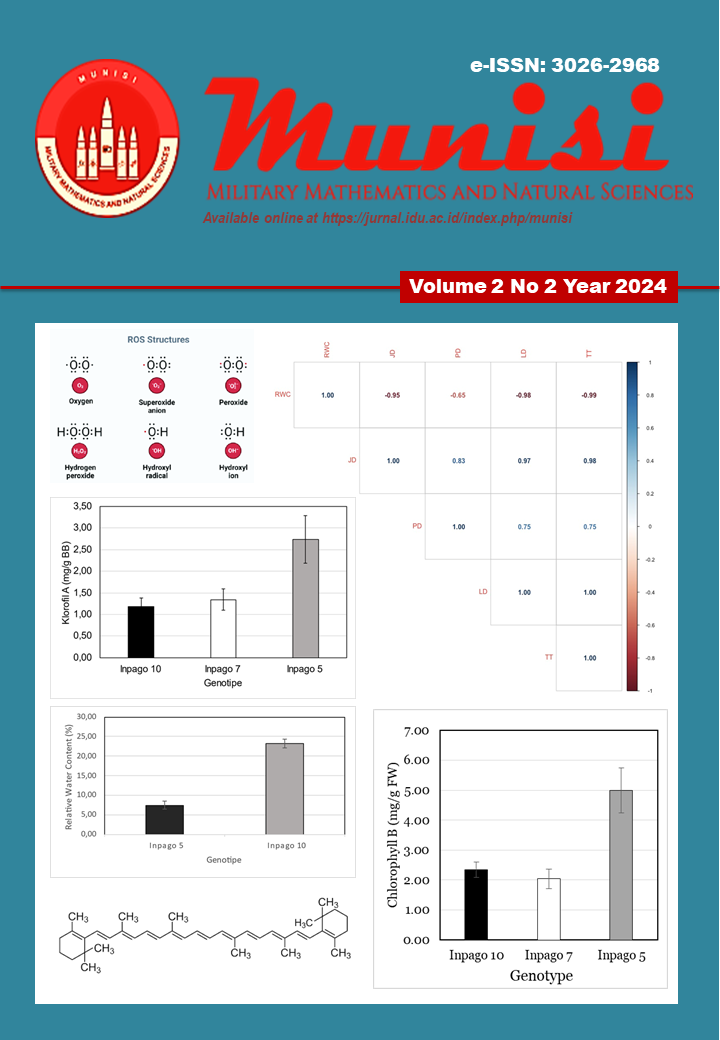
Drought stress poses a major challenge in rice cultivation, particularly in dryland areas, as it inhibits plant growth and significantly reduces yield. Rice plants that are not drought-tolerant often suffer damage during critical growth phases, necessitating the development of rice varieties that possess resilience to drought stress to ensure food security. This study aims to identify rice genotypes with the highest chlorophyll B content, which may be more resistant to drought conditions, allowing them to be developed as superior varieties in water-scarce areas. The experiment involved measuring the highest chlorophyll B content in each test plant with three replications. Subsequently, the data were correlated with physiological traits such as leaf length, leaf count, and root length. We found that the highest chlorophyll B content was observed in the Inpago 5 rice variety, which positively correlated with leaf length, leaf width, and plant height. Therefore, chlorophyll B content can be used as an indicator of drought stress resistance in rice.
References
Akram, H. M., Ali, A., Sattar, A., Rehman, H. S. U., & Bibi, A. (2013). Impact of water deficit stress on various physiological and agronomic traits of three Basmati rice (Oryza sativa L.) cultivars. Journal of Animal and Plant Sciences, 23(5), 1415–1423.
Hassan, M. A., Dahu, N., Hongning, T., Qian, Z., Yueming, Y., Yiru, L., & Shimei, W. (2023). Drought stress in rice: morpho-physiological and molecular responses and marker-assisted breeding. Frontiers in Plant Science, 14(July), 1–16. https://doi.org/10.3389/fpls.2023.1215371
Jamil, A. (2016). Mekanisme Respon Tanaman Padi terhadap Cekaman Kekeringan dan Varietas Toleran. Iptek Tanaman Pangan, 11(1).
Mudhor, M. A., Dewanti, P., Handoyo, T., & Ratnasari, T. (2022). Pengaruh Cekaman Kekeringan Terhadap Pertumbuhan dan Produksi Tanaman Padi Hitam Varietas Jeliteng. Agrikultura, 33(3), 247. https://doi.org/10.24198/agrikultura.v33i3.40361
Oukarroum, A., Madidi, S. El, Schansker, G., & Strasser, R. J. (2007). Probing the responses of barley cultivars (Hordeum vulgare L.) by chlorophyll a fluorescence OLKJIP under drought stress and re-watering. Environmental and Experimental Botany, 60(3), 438–446. https://doi.org/10.1016/j.envexpbot.2007.01.002