Estimasi Laju Erosi Pada Beberapa Daerah Tangkapan Air Waduk Di Daerah Aliran Sungai Bengawan Solo Dengan Sistem Informasi Geografi
DOI:
https://doi.org/10.32679/jsda.v8i1.355Keywords:
Erosion, USLE, GIS, Cathment Area, Soil erodibilityAbstract
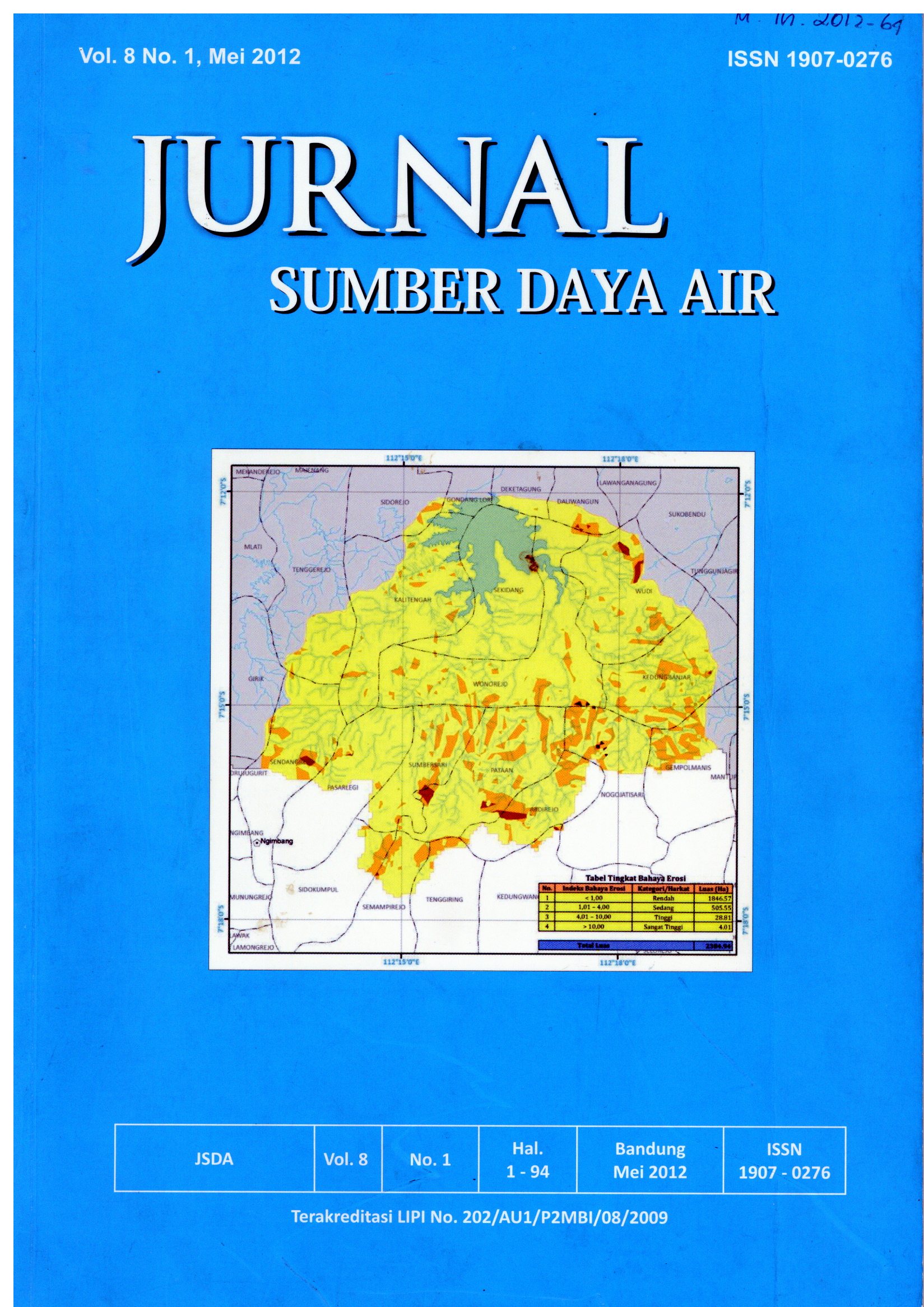
Soil affected by erosion will be carried by the flow of surface water into the river and would enter into the reservoir. This causes siltation of reservoirs that have done studies to estimate the amount of erosion rate in this case performed on Dawuhan Reservoir Catchment Area, Gondang Reservoir, and Nglambangan Reservoir, Bengawan Solo River Basin. One method often used in measuring the level of vulnerability to erosion is a method of USLE (Universal Soil Loss Equation). Erosion prediction with USLE method can also use GIS in its calculations. Geographic Information System (GIS) is a spatially-based technologies that are very popular today. Utilization of GIS-based spatial modeling pixels as a tool in predicting erosion can help the accuracy of the data generated, especially on lands that have a complex topography. The results of the analysis can be concluded greatest erosion rate occurred in the catchment areas of Nglambangan Reservoir with 75,327.93 tons / year with erosion rate27,18 tons/Ha/year. The rate of erosion found on the location of the second largest Gondang Reservoir with a total annual erosion rate of 7,347.77 tons / year with erosion rate 3,08 tons/Ha/year.
Downloads
Published
2018-03-12
How to Cite
Yuningsih, S. M., Raharja, B., Sudono, I., & Fauzi, F. (2018). Estimasi Laju Erosi Pada Beberapa Daerah Tangkapan Air Waduk Di Daerah Aliran Sungai Bengawan Solo Dengan Sistem Informasi Geografi. JURNAL SUMBER DAYA AIR, 8(1), 39–52. https://doi.org/10.32679/jsda.v8i1.355
Issue
Section
ARTIKEL
Citation Check
License
Authors who publish in Jurnal Sumber Daya Air agree to the following terms:
- Authors retain copyright and grant the journal right of first publication with the work simultaneously licensed under a Attribution-ShareAlike 4.0 International (CC BY-SA 4.0) License that allows others to share the work with an acknowledgment of the work's authorship and initial publication in this journal.
- Authors are able to enter into separate, additional contractual arrangements for the non-exclusive distribution of the journal's published version of the work (e.g., post it to an institutional repository or publish it in a book), with an acknowledgment of its initial publication in this journal.
- Authors are permitted and encouraged to post their work online (e.g., in institutional repositories or on their website) prior to and during the submission process, as it can lead to productive exchanges, as well as earlier and greater citation of published work (See The Effect of Open Access).