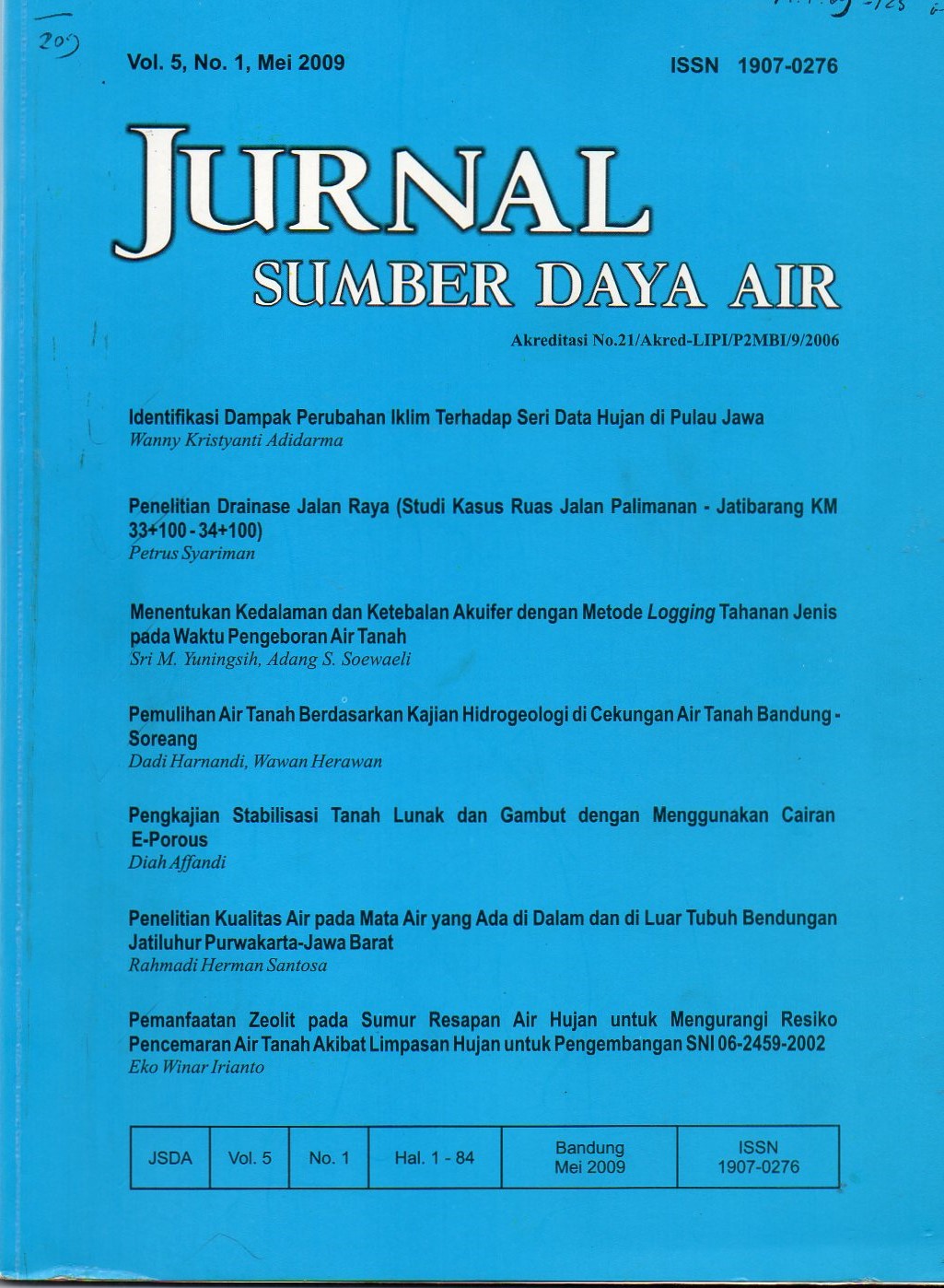
MENENTUKAN KEDALAMAN DAN KETEBALAN AKUIFER DENGAN METODE LOGGING TAHANAN JENIS PADA WAKTU PENGEBORAN AIR TANAH
DOI:
https://doi.org/10.32679/jsda.v5i1.460Keywords:
Depth & thickness of aquifer, resistivity logging, groundwaterAbstract
The aim of this resistivity logging measurement is to decide the stratification of rock and distribution of
aquifer based on the resistivity value. The objective of the well logging is to determine the depth and thickness
of aquifer for well construction, in order to decide the position of screen in the aquifers .Interpretation results
of the resistivity logging of aquifer of sand and sandy tuff vary between 20 – 40 ohm-m and 60 – 115 ohm-m for
breccia. Groundwater in the Ciparay and Cibodas areas is predicted in the depth of 42 – 66 m and 75 – 108 m,
consisting of intercalation of young volcanic fan and Bandung lake deposit. The aquifer in Dago area is less
than 100 m deep representing young volcanic deposit including the Cibeureum Formation, whereas aquifers
with a depth of more than 100 m comprise volcanic deposit, including the Cikapundung Formation. It is
recommended to extract groundwater from more than 50 m deep, in order to prevent influence to phreatic
aquifer as excavated well. The minimum kind of well logging for groundwater drilling should consist of
resistivity, self-potential and gamma ray logging.
References
Adang S.Soewaeli, 2004, Tata cara
Pencatatan Akuifer Dengan Metode
Logging Geolistrik Tahanan Jenis Short
Normal dan Long Normal Dalam Rangka
Eksplorasi Air Tanah, RSNI T-05-2004,
SNI, Badan Standar Nasional, BSN.
Assad Fakhry, 2004, Field Methods for
Geologist and Hydrogeologists, Springer
– Verlag, Berlin-Heidelberg 2004, Printed
in Germany.
Bruce Misstear, 2006, Water Wells and
Boreholes, John Wiley & Sons Ltd, The
Atrium, Southern Gate, Chichester, West
Sussex PO19 8SQ, England.
Kevin Hiscock, 2005, Hydrogeology
Principles and Practice, Blackwell
Publishing Science Ltd, USA
Kollert, 1969, Groundwater Exploration
By The Electrical Resistivity Method,
Geophysical Memorandum 3,
Geophysics &Electronics, Atlas Copco
ABEM, Sweden.
Reinhard Kirsch, 2006, Groundwater
Geophysics, A Tool For Hydrogeology,
Springer-Verlag, Berlin-Heidelberg
, Printed in Germany
Downloads
Published
How to Cite
Issue
Section
Citation Check
License
Authors who publish in Jurnal Sumber Daya Air agree to the following terms:
- Authors retain copyright and grant the journal right of first publication with the work simultaneously licensed under a Attribution-ShareAlike 4.0 International (CC BY-SA 4.0) License that allows others to share the work with an acknowledgment of the work's authorship and initial publication in this journal.
- Authors are able to enter into separate, additional contractual arrangements for the non-exclusive distribution of the journal's published version of the work (e.g., post it to an institutional repository or publish it in a book), with an acknowledgment of its initial publication in this journal.
- Authors are permitted and encouraged to post their work online (e.g., in institutional repositories or on their website) prior to and during the submission process, as it can lead to productive exchanges, as well as earlier and greater citation of published work (See The Effect of Open Access).