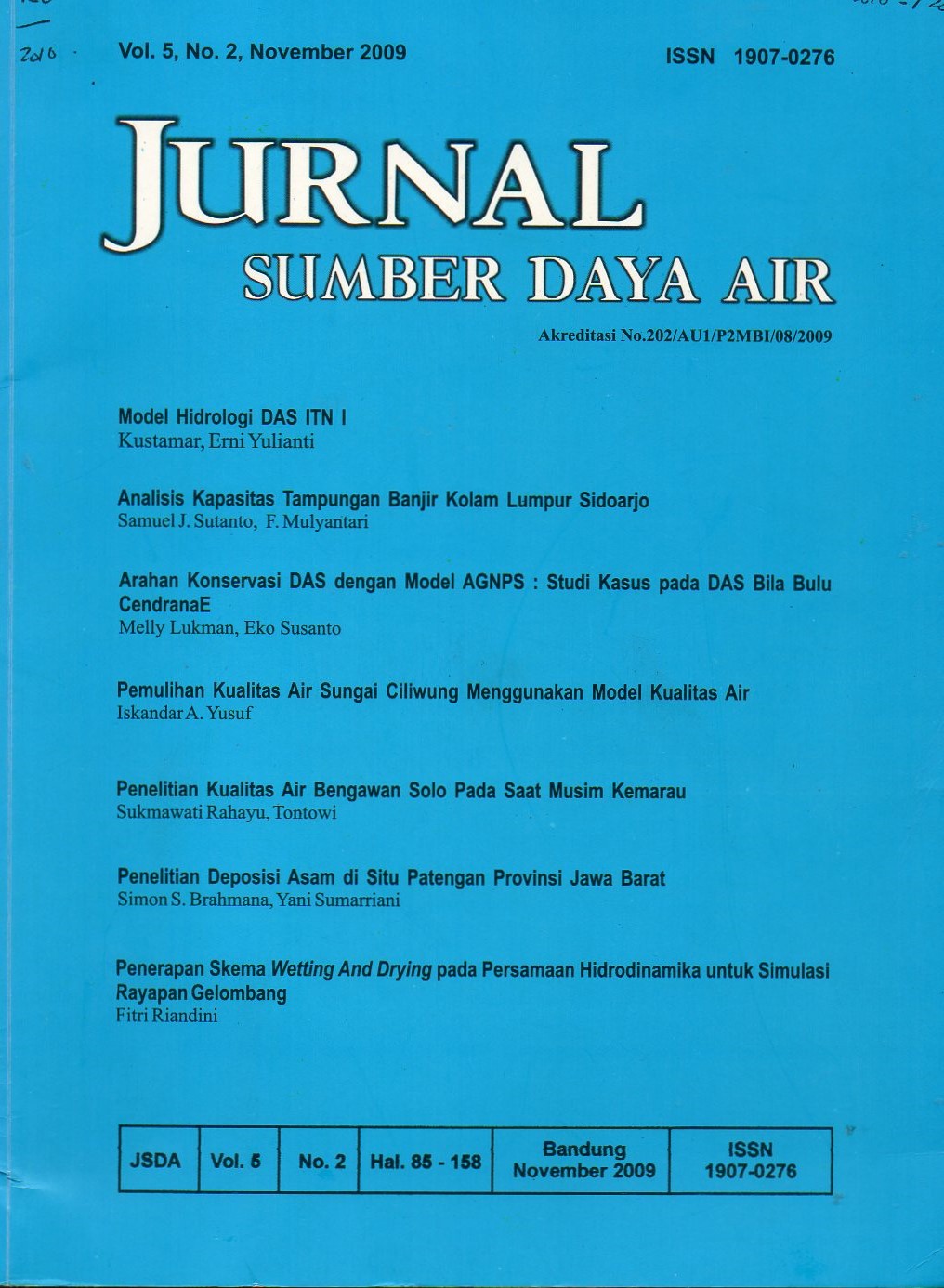
ARAHAN KONSERVASI DAS DENGAN MODELAGNPS :STUDI KASUS PADA DAS BILA BULU CENDRANAE
DOI:
https://doi.org/10.32679/jsda.v5i2.470Keywords:
Watershed, Hydrology Model, Model AGNPS.Abstract
Soil and water conservation activities in a watershed must be monitored, so that results in watershed
management are known. The activities are to be implemented using an accurate method for evaluating the
impact of conservation activities in accordance with the improvement of watershed condition. Evaluation of
watershed condition should use hydrology parameters measured at the outlet of a watershed, and be
explained quantitatively as a result of direct measurement. Such kind of evaluation can be used if
appropriate instruments have been placed in the watershed. The number of watersheds or sub-watersheds
provided with sufficient amount of instruments is very limited. Using a model to evaluate the watershed
condition is one of the alternatives in finding solution to the above-mentioned problem. One of these models
is the AGNPS Model. A study with application of such model was carried out in the Bila Bulu CendranaE
watershed (South Sulawesi), and results show that the second scenario is the most suitable to improve the
Bila Bulu CendranaE watershed condition.
References
Arsyad, S. (2000).
Bogor: IPB Press.
Asdak, C. (2002).
Yogyakarta: Gadjah
Mada University Press.
Beffa Cornel and Rober J. Connell (2001),
, Journal of Hydrologic Engineering,
ASCE, Vol. 6, No. 5 September/
October 2001, pp.397- 405.
Burges J Stephen, Wigmosta and Meena M
Jack, (1998
Journal of Hydrologic Engineering, ASCE,
Vol. 3, Number 2,April 1998, pp 86 – 97.
Darby E. Stephen, (1999).
Journal of Hydraulic Engineering,
ASCE, Vol.125, Number 5, May 1999, pp 443
– 454
Kilgore, Roger T. Sheldon A. and Davis, Mik
(2004)
Kilgore Consulting and Management, Denver
Colorado
Hariyadi, R. (1988).
Makalah
Simposium Model Hidrologi Rekayasa dan
Lingkungan Untuk Perencanaan Regional dan
Perancangan. Bandung, 17-18 Maret 1988.
Jacobs M., Jennifer and Min-HuiWang, (2003),
Journal of Hydrologic Engineering,
ASCE, Vol.8, No. 2, March/April 2003, pp.99-
Lund ,. Jay R. (2002
, Journal ofWater
Resources Planning and Management, ASCE,
Vol. 127, Number 3, May/June 2002, pp143-
McCuen H. Richard, (2001),
Journal of Hydrologic Engineering, ASCE,
Vol.6 No.4, July/August 2001, pp.293-299.
Nugroho, S.P. (2001).
Jurnal
Alami, Volume 6 Nomor 1 Tahun 2001, ISSN :
-8514. Jakarta: Direktorat Teknologi
Pengelolaan Sumberdaya Lahan dan Kawasan,
Deputi Bidang Teknologi Pengelolaan
Sumberdaya Alam, Badan Pengkajian dan
PenerapanTeknologi.
Purwanto, E. (1992).
(Majalah
Kehutanan Indonesia, Edisi No. 10 th
/1992, Diterbitkan oleh Departemen
Kehutanan RI, STT. No.1162/SK/DITJEN
PPG / SST / 1987). Jakarta: Departemen
Kehutanan RI.
Shrivastava S. Gyan, (2003),”
Journal of Hydrologic Engineering, ASCE,
Vol.6, No. 1, January/February, pp.35-40.
Undang-undang No. 7 Tahun 2004 tentang
Sumber dayaAir.
Wright, J.A.( 2002).
, Virgin
Islands Nonpoint Source Pollution Control
Committee, Virgin Islands Department of
Planning and Natural Resources, St. Croix,
U.S.Virgin Islands.
Young, R.A., C.A. Onstad, D.D. Bosch, W.P
Anderson. (1990).
USDA-ARS, Morris, Minnesota.
Young, R.A., C.A. Onstad, and D.D. Bosch.
(1995).
Chapter 26 in Computer
Models of Watershed Hydrology, Pp. 1001-
, edited by V.P. Singh. Water Resource
Publications. Colorado.
Downloads
Published
How to Cite
Issue
Section
Citation Check
License
Authors who publish in Jurnal Sumber Daya Air agree to the following terms:
- Authors retain copyright and grant the journal right of first publication with the work simultaneously licensed under a Attribution-ShareAlike 4.0 International (CC BY-SA 4.0) License that allows others to share the work with an acknowledgment of the work's authorship and initial publication in this journal.
- Authors are able to enter into separate, additional contractual arrangements for the non-exclusive distribution of the journal's published version of the work (e.g., post it to an institutional repository or publish it in a book), with an acknowledgment of its initial publication in this journal.
- Authors are permitted and encouraged to post their work online (e.g., in institutional repositories or on their website) prior to and during the submission process, as it can lead to productive exchanges, as well as earlier and greater citation of published work (See The Effect of Open Access).