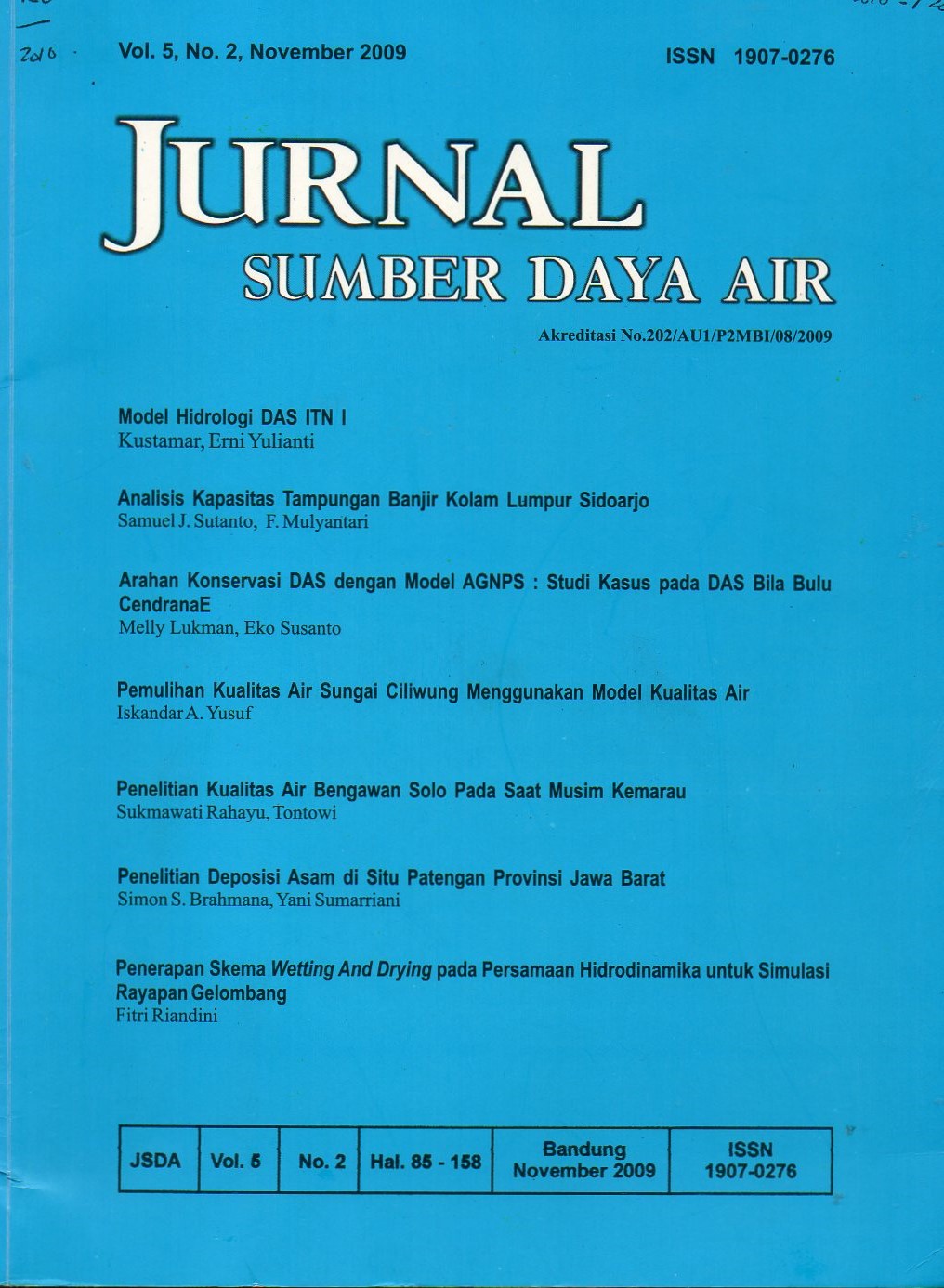
PENELITIAN KUALITAS AIR BENGAWAN SOLO PADA SAAT MUSIM KEMARAU
DOI:
https://doi.org/10.32679/jsda.v5i2.472Keywords:
water river, water quality, self purificationAbstract
The Bengawan Solo which flows through Central and East Java is the largest river in Java Island, and its
water is used for various activities such as agriculture, fishery, domestic use, irrigation, and water
resources for drinking water. Based on a research carried out in upstream Bengawan Solo, water quality
shows a decline indicated by the decrease of dissolved oxygen and increase of BOD and COD. At location
Grogol, dissolved oxygen ranges between 4.4 – 7.9 mg/L and decreases at Kemiri to 0 – 6.4 mg/L. BOD at
Grogol shows a range between 1.3 – 4.5 mg/L increasing to 4.8 – 8.1 mg/L at Kemiri. COD range between
3.7-13 mg/L at Grogol increases to 12 – 30 mg/L at Kemiri. In downstream Bengawan Solo, at location
Napel and Babat, water quality indicates an increase indicated by increase of dissolved oxygen, and
decrease ofBODand COD. The increasing dissolved oxygen and decreasingBODandCODin downstream
area shows that the self purification process is happening in the river. The Fecal coli form bacteria at each
location is found very high and beyond criteria.
Downloads
Published
How to Cite
Issue
Section
Citation Check
License
Authors who publish in Jurnal Sumber Daya Air agree to the following terms:
- Authors retain copyright and grant the journal right of first publication with the work simultaneously licensed under a Attribution-ShareAlike 4.0 International (CC BY-SA 4.0) License that allows others to share the work with an acknowledgment of the work's authorship and initial publication in this journal.
- Authors are able to enter into separate, additional contractual arrangements for the non-exclusive distribution of the journal's published version of the work (e.g., post it to an institutional repository or publish it in a book), with an acknowledgment of its initial publication in this journal.
- Authors are permitted and encouraged to post their work online (e.g., in institutional repositories or on their website) prior to and during the submission process, as it can lead to productive exchanges, as well as earlier and greater citation of published work (See The Effect of Open Access).