Pemetaan Potensi Sumber Mata Air DAS Bedadung Berbasis Penginderaan Jauh Menggunakan Metode Frekuensi Rasio
DOI:
https://doi.org/10.32679/jsda.v21i2.934Keywords:
spatial analysis, Bedadung Watershed, Frequency Ratio (FR), Geographic Information Systems (GIS), AUCAbstract
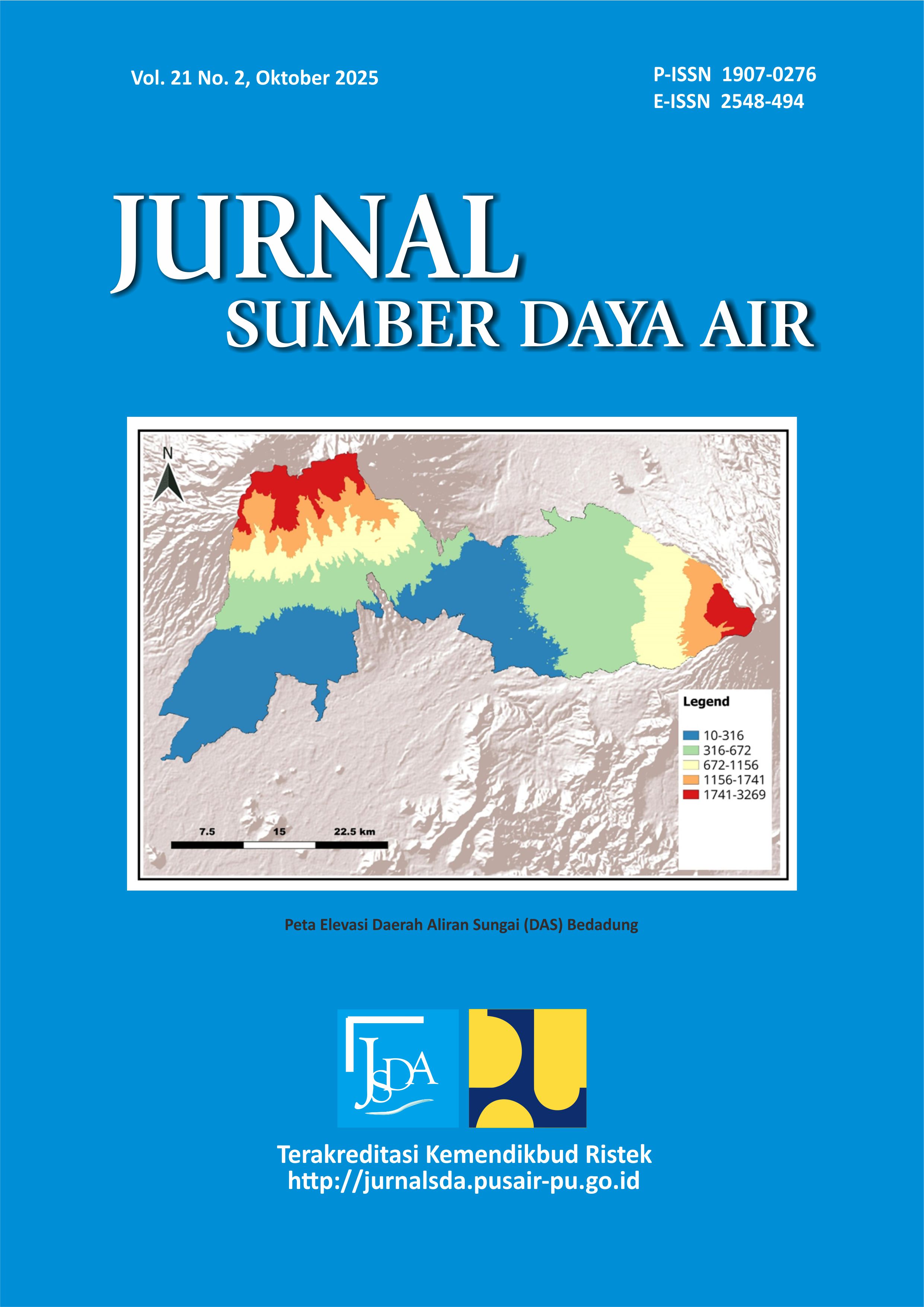
The Frequency Ratio (FR) method combined with Geographic Information Systems (GIS) was applied to map groundwater potential in the Bedadung Watershed, Jember Regency, Indonesia. The study was conducted from September 2024 to January 2025 by analyzing 136 spring locations across an area of 9,590.83 km². The main objectives were to identify factors influencing groundwater potential, validate the predictive model using the Area Under the Curve (AUC) method, and produce a detailed groundwater potential map. A total of 14 environmental parameters were considered, including Elevation, slope, and vegetation density. Model validation produced an AUC value of 73.8%, indicating a good level of predictive accuracy. The highest groundwater potential was observed in the sub-districts of Sukorambi, Arjasa, Sukowono, and Kalisat, where more than 50% of the area falls into the very high potential category. In contrast, Panti Sub-district demonstrated limited groundwater availability, with 59% of its area classified as low to very low potential. The resulting groundwater potential map was classified into five categories: very low, low, moderate, high, and very high. These findings provide a scientific basis for sustainable water resource management, emphasizing conservation strategies in high-potential areas and infrastructure development in low-potential zones. The effectiveness of the FR method in spatial analysis is reaffirmed, offering valuable insights for groundwater management in the Bedadung Watershed.
Downloads
Published
How to Cite
Issue
Section
Citation Check
License
Authors who publish in Jurnal Sumber Daya Air agree to the following terms:
- Authors retain copyright and grant the journal right of first publication with the work simultaneously licensed under a Attribution-ShareAlike 4.0 International (CC BY-SA 4.0) License that allows others to share the work with an acknowledgment of the work's authorship and initial publication in this journal.
- Authors are able to enter into separate, additional contractual arrangements for the non-exclusive distribution of the journal's published version of the work (e.g., post it to an institutional repository or publish it in a book), with an acknowledgment of its initial publication in this journal.
- Authors are permitted and encouraged to post their work online (e.g., in institutional repositories or on their website) prior to and during the submission process, as it can lead to productive exchanges, as well as earlier and greater citation of published work (See The Effect of Open Access).