Prediksi Debit Banjir Rancangan Menggunakan Metode Hidrograf Satuan SCS pada DAS Aesesa untuk Mitigasi Resiko Banjir
DOI:
https://doi.org/10.32679/jsda.v22i1.987Keywords:
TRMM, GEV, HEC-HMS, observation, vulnerabilityAbstract
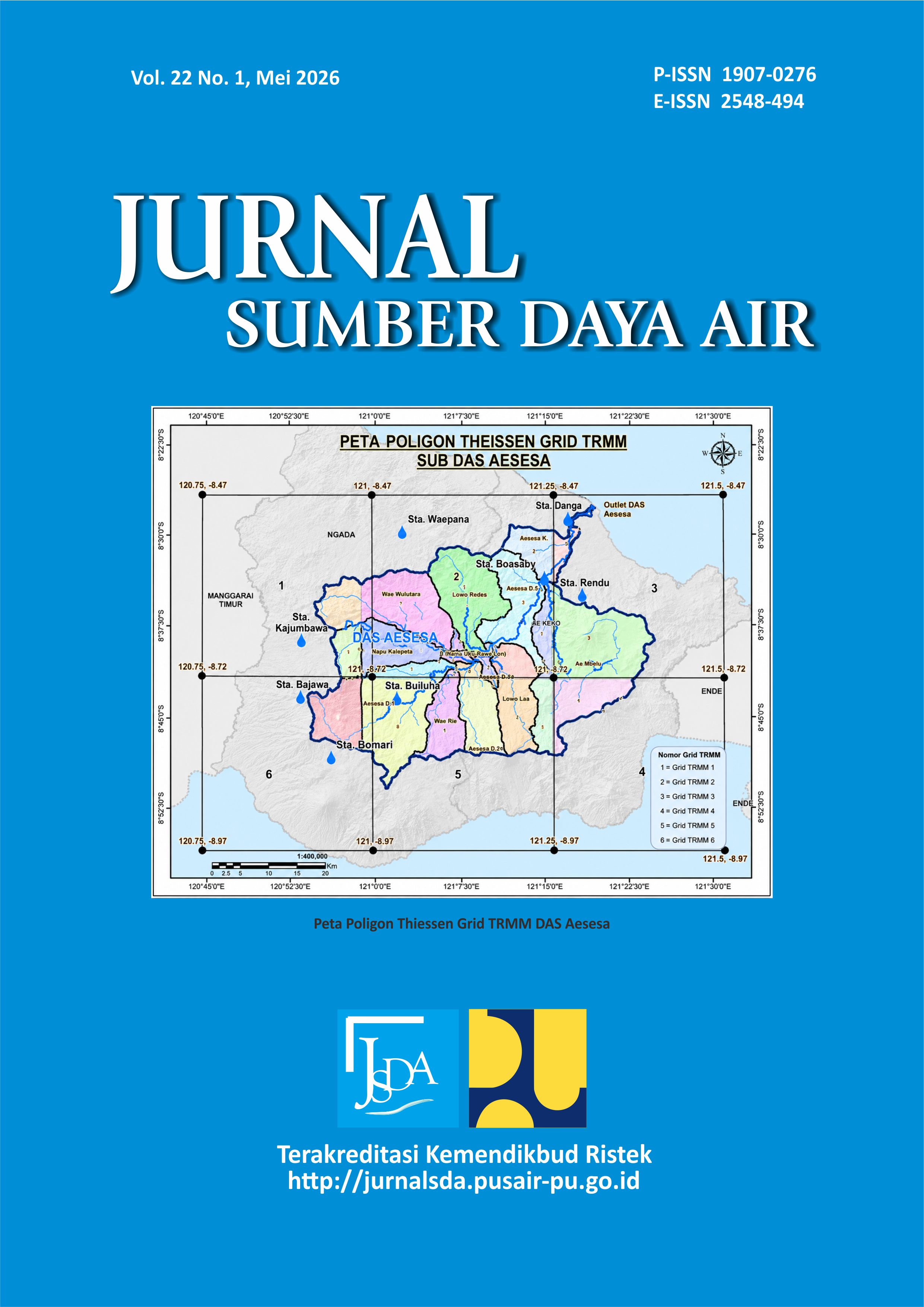
The Aesesa River Basin is located in the Ngada and Nagekeo Regencies on Flores Island, with a basin area of 1,169.24 km2. The purpose of this research is to analyze the flood discharge of the Aesesa River Basin based on the Natural Resources Conservation Service (NRCS), USA Curve Number infiltration method, and the Synthetic Unit Hydrograph (SCS) method. Rainfall data used satellite TRMM corrected with rain gauge data, with a data length of 20 years (2000 – 2019). Observed discharge using the Boasaby staff gauge (SG) and basin characteristics using the Geographical Information System (GIS). Design rainfall analysis used the Generalized Extreme Value (GEV) distribution. Flood analysis used the soil conservation service synthetic unit hydrograph method (HSS SCS) with the aid of HEC-HMS software. The research results show that land cover is dominated by savanna and shrub vegetation, and soil types with low permeability result in a CN value of 77.77. Flood discharge analysis was subsequently performed for various return periods. The observed flood discharge obtained from hydraulic calculations using the continuity equation was approximately 405.19 m³/s. The calculated flood discharge for the 2-year return period was 250.10 m3/s. Meanwhile, at return periods of 5, 10, 25, 50, 100, 200, 500, and 1000 years, the flood discharge is 480.10 m3/s, 691.80 m3/s, 1036.10 m3/s, 1365.90 m3/s, 1759.70 m3/s, 2231.00 m3/s, 3020.90 m3/s, and 3755.30 m3/s respectively, all exceeding the observed flood discharge. These results indicate that the relatively high Curve Number (CN) value in the Aesesa Watershed reflects low infiltration capacity, thereby contributing to increased surface runoff.
Downloads
Published
How to Cite
Issue
Section
Citation Check
License
Authors who publish in Jurnal Sumber Daya Air agree to the following terms:
- Authors retain copyright and grant the journal right of first publication with the work simultaneously licensed under a Attribution-ShareAlike 4.0 International (CC BY-SA 4.0) License that allows others to share the work with an acknowledgment of the work's authorship and initial publication in this journal.
- Authors are able to enter into separate, additional contractual arrangements for the non-exclusive distribution of the journal's published version of the work (e.g., post it to an institutional repository or publish it in a book), with an acknowledgment of its initial publication in this journal.
- Authors are permitted and encouraged to post their work online (e.g., in institutional repositories or on their website) prior to and during the submission process, as it can lead to productive exchanges, as well as earlier and greater citation of published work (See The Effect of Open Access).