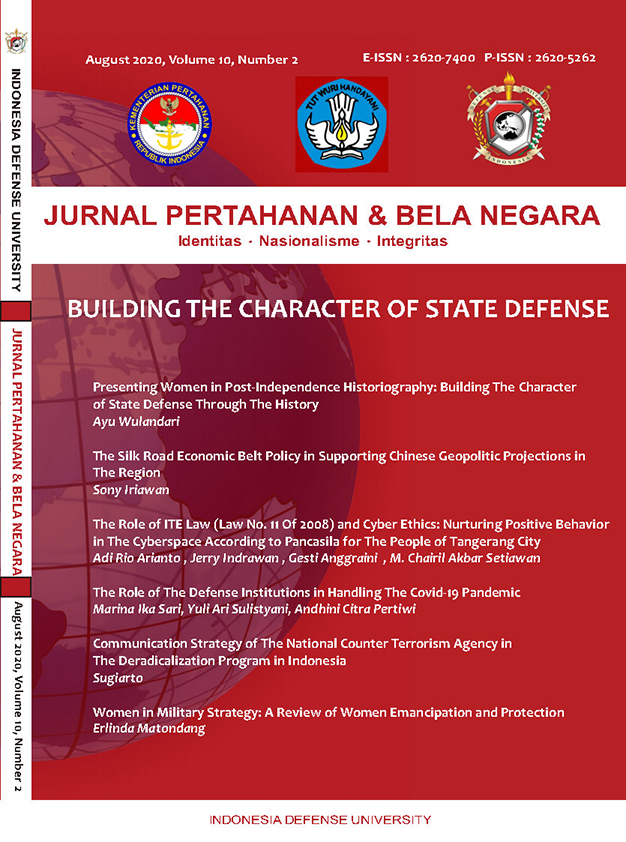
WOMEN IN MILITARY STRATEGY: A REVIEW OF WOMEN EMANCIPATION AND PROTECTION
DOI:
https://doi.org/10.33172/jpbh.v10i2.899Abstract
Whether in conflict and war or peacebuilding, women are always considered victims of human rights violation and the vulnerable. In recent decades, there has been efforts to advocate for the protection of women's rights and women empowerment in the name of emancipation. This has allowed women's presence in several key sectors, including politics and military, resulting in a new role for women as resources in military strategy. This has put the policy to protect women during war into question, especially when women have now become a combatant. This paper analyzes this issue through two concepts (women protection and military strategy to understand the military's perception toward women's position and one theory (feminism) to understand women's perception toward their roles in the military during war. Therefore, the object of this observation is the role of women in military strategy with regard to the implementation of women' rights protection and military strategy. In this observation, this paper collects secondary data through literature review. Through this observation, we can have broader understanding of the role of women in military strategy because the primary purpose of this paper is to assess the possibility for changing women protection during war policy to reflect the current condition.
Keywords: emancipation, human rights, military strategy, women protectionReferences
Book
Burchill, S., et al. (Ed.). (2005). Theories of International Relations Third Edition. New York: Palgrave Macmillan.
Pease, A. & B. (2001). Why Men Don't Listen & Women Can't Read Maps. Queensland: Pease International Pty, Ltd.
Kaufman, J.P. dan Williams, K.P. (2013). Women at War, Women Building Peace: Challenging Gender Norms. Boulder: Kumarian Press.
Thesis
Martinez, K.M. (2017). Women's Work: Incorporating Females into the United States Military Strategy to Contain and Degrade Boko Haram. Kansas: Fort Leavenworth.
Journal
Cardenas, M.L. (2019). Women-to-women Diplomacy in Georgia: Peacebuilding Strategy in Frozen Conflict. Civil Wars, Volume 21, No. 3, pp. 385-409.
Obradovic, L. (2015). Comparative Analysis of Women's Military Participation in East Asia. Res Militaris, Ergomas, Part One, September 2015.
Shepherd, C.K. (2015). The Role of Women in International Conflict Resolution. Journal of Public Law & Policy, Volume 36, Issue 2, Article 1, pp. 53-67.
Tachou-Sipowo, A. (2010). The Security Council on women in the war: between peacebuilding and humanitarian protection. International Review of the Red Cross, Volume 92 No. 877, pp. 197-219.
Timur, F.B. (2016). The Tales of the Three Asian Countries: How Indonesia, India, and the Philippines Recruited Women for UN Peacekeeping Missions. Global, Volume 18 No. 1, pp. 51-75.
Report
International Committee and the Red Cross. (Maret 2003). Women and War: Special Report.
Bulletin
Austrian Development Cooperation. (October 2009). Focus: Women, Gender and Armed Forces. Vienna: Austrian Development Cooperation.
Website
United Nations. Security Council Resolution 1325, https://www.peacewomen.org/SCR-1325, accessed on 10 May 2020.
Downloads
Published
How to Cite
Issue
Section
Citation Check
License
Proposed Policy for Journals That Offer Open Access. Authors who publish with this journal agree to the following terms:
- Authors retain copyright and grant the journal right of first publication with the work simultaneously licensed under a Creative Commons Attribution License that allows others to share the work with an acknowledgement of the work's authorship and initial publication in this journal.
- Authors are able to enter into separate, additional contractual arrangements for the non-exclusive distribution of the journal's published version of the work (e.g., post it to an institutional repository or publish it in a book), with an acknowledgement of its initial publication in this journal.
- Authors are permitted and encouraged to post their work online (e.g., in institutional repositories or on their website) prior to and during the submission process, as it can lead to productive exchanges, as well as earlier and greater citation of published work (See The Effect of Open Access).
Proposed Policy for Journals That Offer Delayed Open Access. Authors who publish with this journal agree to the following terms:
- Authors retain copyright and grant the journal right of first publication, with the work [SPECIFY PERIOD OF TIME] after publication simultaneously licensed under a Creative Commons Attribution License that allows others to share the work with an acknowledgement of the work's authorship and initial publication in this journal.
- Authors are able to enter into separate, additional contractual arrangements for the non-exclusive distribution of the journal's published version of the work (e.g., post it to an institutional repository or publish it in a book), with an acknowledgement of its initial publication in this journal.